
Published · Loren Wernette
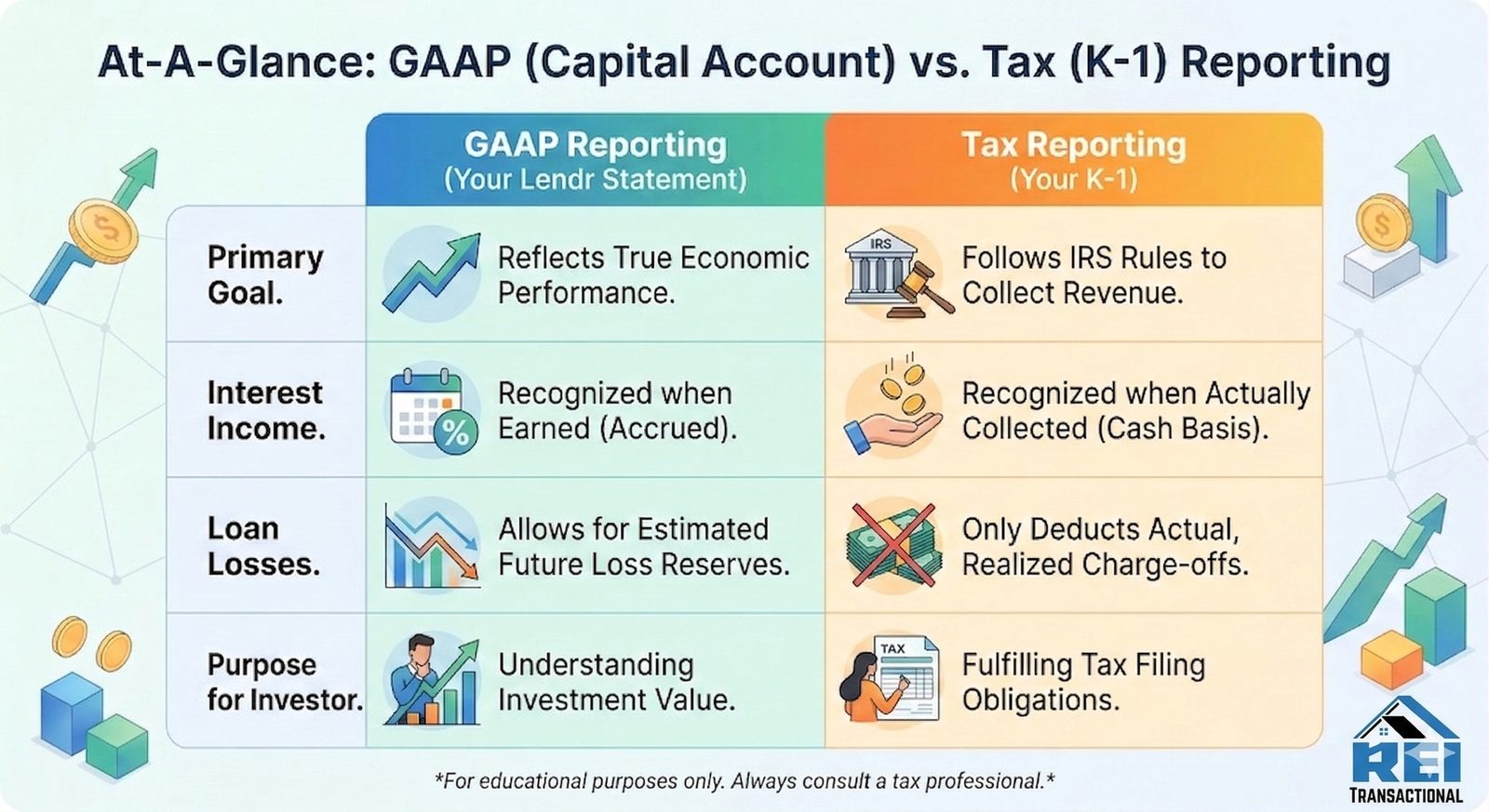
Tax season is officially upon us. As you review your K-1 and end-of-year statements, you might notice something confusing: the numbers don’t match. Before you reach for the extra-strength aspirin, we want to assure you — this is completely normal. In the world of finance, we essentially speak two different languages at the same time: GAAP (Generally Accepted Accounting Principles) and Tax.
As your investor relations team, we want to pull back the curtain on why these two systems tell different stories and help you understand which one to look at for the true “health” of your investment. The discrepancy exists because GAAP accounting measures economic performance, while tax reporting follows IRS rules designed to collect revenue. For an accurate picture of the current value of your investment, refer to your capital account statement in the investor portal.
The “Why” Behind the Two Systems
At a high level, these two frameworks exist for fundamentally different reasons.
GAAP (the economic truth): This is designed to give you an accurate picture of our business’s economic performance. It’s what we use to manage the company and how we measure the actual value of your capital.
Tax (the IRS playbook): IRS rules are designed to collect revenue and incentivize certain economic behaviors. It’s less about “how is the business doing?” and more about “what is owed according to the law?”
Five Key Drivers of the “Discrepancy”
So, where exactly do the paths diverge? Here are the five main reasons your K-1 might look different from your statement.
1. Loan origination fees: timing is everything. Under GAAP, we spread (amortize) loan fees over the entire life of the loan to show a steady yield. However, tax rules often require or allow different timing. This means the income might show up “faster” or “slower” for the IRS than it does on your economic statement.
2. Interest income: accrued vs. collected. This is a big one. GAAP recognizes income as it is earned — even if the borrower hasn’t sent the check yet. For a company of our size, tax rules only require us to report interest that we have actually collected in cash.
3. Loan losses: looking forward vs. looking back. GAAP requires us to be conservative. We set aside “reserves” for estimated future credit losses, which reduces our reported income today. The IRS, however, doesn’t care about what might happen. They generally only allow deductions for actual charge-offs — meaning losses we’ve already realized.
4. Partnership allocations. Tax law is a bit rigid when it comes to how income is distributed among partners (that’s you!). We must follow specific IRS rules regarding “substantial economic effect.” This can sometimes result in a tax allocation that looks slightly different from the actual economic split reflected in your capital account.
5. General timing differences. Think of this as a “calendar clash.” An expense that we deduct entirely this year for tax purposes might be spread across three years for GAAP. These differences eventually even out over time, but in any single year, they create a gap between the two reports.
Which Number Should I Focus On?
If you are looking for an accurate picture of the current value of your investment and how your capital is performing, refer to your capital account statement. As we continue to grow, the gap between these two reporting methods may widen, but that is simply a byproduct of a scaling portfolio and complex tax code — not a reflection of diminishing returns.
Thank you for your continued trust and for investing with us. If you have specific questions about your statements, our IR team is always here to help you navigate the nuances.
Disclaimer: This article is for educational purposes only and does not constitute tax or legal advice. Please consult with your tax professional regarding your specific K-1 filing.
Related: if the interest is held in a retirement account, how to invest your IRA in real estate explains when the IRA itself has to file a return on Form 990‑T.